
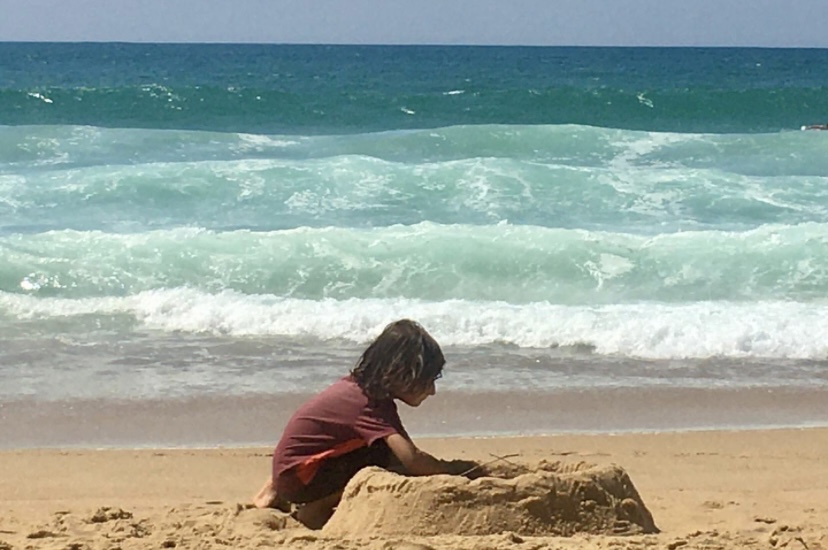
On containment, unschooling and what it actually teaches about boundaries
Unschooling gets read a certain way in this culture. People hear it and picture feral kids, no structure, a lingering neglect vibe hanging over the whole thing. Like freedom and boundaries cancel each other out, like you have to pick one.
I talk about boundaries constantly. Boundaries for kids, boundaries with kids, boundaries with myself, others. I am not the one who mastered them early and want to pass down some wisdom. I actually didn’t learn this anywhere. Not in school, not at home, nobody sat me down and showed me what a healthy limit was or that I was allowed to have one. I spent most of my life qualifying myself as a people pleaser, or an introvert, depending on the room I was in. Two labels for the same missing thing.
The body learns limits before the mind does
Kids need to feel containment. They need to push against something solid and feel where their own body stops and the world starts, before any of this becomes a mental or emotional concept. A body that has never met an edge has nothing to translate the concept of a limit onto later. That physical experience comes first. A parent’s guidance is what turns pushing against a wall into understanding a limit.
This is the part that gets missed in the feral-kids image. Freedom without containment doesn’t produce free kids. It produces kids who never got the chance to find their own edges, because nothing pushed back. Stray kids have a hard time becoming free, unschooled or not. That’s the part nobody expects. There is so much discipline in freedom.
Without boundaries we stay slaves of circumstance, pulled by whatever is louder in the moment. We lose the ability to know what we actually need, and even when we do know, we never learned we were allowed to protect it. We lose ourselves in this or that, whatever is being asked of us, whoever is in the room. Much of society is built on people who never got this training. Adults who can’t say no, who can’t hold a line, who mistake going along with everything for being easy to love.
What happens without this
A child without boundaries gets walked on or they resort to apply anger/violence. Both are the same wound expressed two ways, a child who never got a reliable read on where they end and someone else begins, showing it either by disappearing into what others want or by fighting or dismissing everything that comes near them.
They either tolerate things they should never have to tolerate, because nobody ever handed them the belief that their comfort was worth defending in the first place or they reject everything coming from the outside as a consequence of having lost trust in the adult to guide them properly.
Strong learned boundaries protect kids from doing things just to fit in and are essential in building the template for every mutually respectful relationship they’ll have later.
The moment most parents flinch
Supporting a child’s boundary is easy to talk about and hard to do, especially the moment they turn it on you. In my experience, that’s exactly where most parents hesitate. We want cooperation. When a child pushes back, it can read as defiance.
It isn’t defiance. It’s development. And an act from us is required.
We need to understand when our own freedom is actually touched, and when it isn’t, and act accordingly. If it isn’t touched, we let the kid do their thing. Have their moment of discovery or expression.
If it is, we contain or redirect depending on age. That’s it. That’s the whole mechanism.
Parents who spend most of their day away from their kids, school taking up the bulk of it, end up handing this entire process to someone else by default. And a teacher managing thirty kids at once will never be able to meet each one individually the way this actually requires. What happens is rarely containment and redirection. It’s just punishment, because punishment is what works in the moment when nobody has time to actually meet the kid where they are.
A kid writing on the walls, screaming through the house, or leaving a mess behind isn’t the mirror of what happy and free looks like or unschooling is. He’s a child who needs us to meet him there, because it touches our freedom too, the freedom to not spend an hour cleaning up or repainting something we didn’t choose to have marked. To assert: you can do this, but you take the consequence with you. Otherwise it isn’t acceptable, and the actual removal from the situation follows, depending on age. It’s not punishment. That’s just what it means for two people’s freedom to exist in the same space. And we need to treat our kids as capable of understanding this.
These are boundaries, not rules imposed for their own sake, but a live read of where one person’s freedom ends and another’s begins.
The kid will learn this in reversal. Watching us contain or firmly not accepting something when our own freedom is actually touched is how they learn to do the same thing for themselves, later, with peers, with partners, with their own kids.
What a child learns when “no” is respected
And when a child learns to say no, I don’t like that, please stop, or this is not acceptable, and the adult actually stops and respect that, instead of brushing it off as a joke or waving it away as kids being kids, something shifts. Not just in that moment. In how the child understands their own voice going forward.
Teaching a child they have a right to their own space, their own feelings, their own limits, is teaching them they matter.
A child who can hold a boundary with peers, with siblings, with adults, learns to trust what comes out of their own mouth. They stop scanning the room for approval before deciding how they feel about something, because their own comfort has already been treated as worth protecting.
When you honor your child’s limit, you haven’t lost authority. You’ve shown them their voice has actual power in the world. That single piece of knowledge becomes the foundation under every relationship they will ever build.