On owning less, the particular freedom of a child who knows where home actually is, and the question that quietly stopped one day.
At some point I tried fitting less things in and life got noticeably bigger, which was unexpected and has never stopped being slightly surprising to me.
How it happened
There was no dramatic moment of renunciation. No bonfire of possessions, no manifesto. Just a gradual discovery that every time something left, something else arrived. And it wasn’t a thing. But more like a quality. Space, maybe, or attention, or the particular lightness of not having to manage very much.
We are taught to accumulate. It is presented as progress, as the natural direction of a life moving forward. More space for more things, more things requiring more space, the square footage of our lives expanding to contain what we have convinced ourselves we need. And it happens so incrementally, so naturally, that most people never stop to ask whether the accumulation is actually serving them or whether they have simply become its custodians.
I stopped asking that question and started doing the experiment instead. And the experiment kept returning the same result. Less was more. Not as a slogan. As a lived, repeatable, slightly bewildering fact.
What my son never had
My son has never had his own bedroom. He has never had large amounts of toys, or the full complement of things people give children when they are trying to fill the voids that a certain kind of lifestyle creates in them.
I want to be careful with that sentence because it is not a judgment of the people who give those things. It is an observation about what the giving is sometimes trying to do. When children don’t have enough time with their parents, enough unstructured space, enough genuine freedom, things arrive to compensate. Stuff stands in for presence. Quantity substitutes for quality. The bedroom becomes a contained world because the actual world has not been made available.
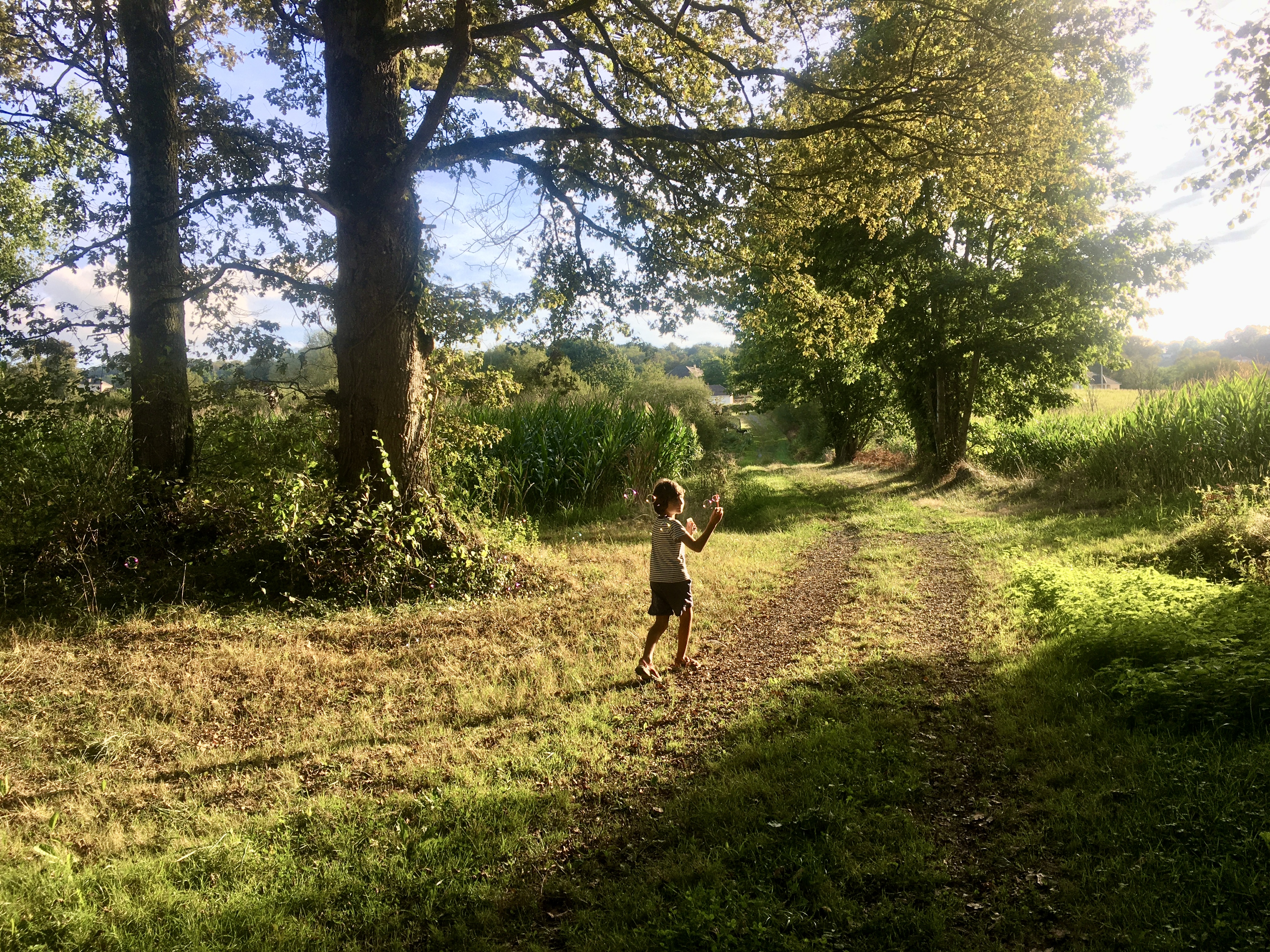
My son has had forests instead. Coastlines, fires at sunset, the right to boredom and the creativity that emerges from it when you don’t fill the gap immediately with a screen or a toy. He has had three stuffed animals that lasted ten years, which tells you something about what children actually bond with when they are not being offered an endless stream of replacements.
And he has had the particular freedom of a child who understands that home is not a place you own. It is something that simply is, inside of you.
What he understood at seven
He reached that conclusion on his own, around age seven. I did not teach it to him. It arrived in him through experience, through having lived in enough different places to notice that what felt like home had nothing to do with the address.
That is worth sitting with. A seven-year-old, given the right conditions, arrived independently at something most adults spend decades and significant amounts of therapy trying to understand. That belonging is not located in a postcode. That security is not a property you can purchase. That the feeling of being held does not require four walls and a mortgage.
What is home, really? Is it not the very Earth we are living on? The sky that is always above wherever we happen to be? I feel held in ways that are difficult to explain to people whose sense of safety is attached to a fixed location, and I am glad my son seems to have found already, at twelve, a peace and an awareness that most people cannot find in a lifetime.
The question that stopped
I used to wonder if I was giving him enough.
It is the question that shadows every unconventional parenting choice, the one that arrives at three in the morning and makes a very convincing case for doubt. What if he needs what other children have. What if the absence of the standard things leaves a gap that only shows up later. What if I am wrong about all of this.
That question just stopped one day. And never came back.
Not because I found proof, or received reassurance, or reached some conclusion. It stopped because I kept watching him. Watching how he moved through the world, how he made himself at home in himself, how he met strangers, how he handled difficulty, how he spent his time when no one was telling him what to do with it.
And the evidence accumulated until the question simply had nothing left to stand on.
What enough actually looks like
Enough is not a quantity. That is the thing no one tells you, possibly because it is very bad for the economy.
Enough is a relationship with what you have. It is the capacity to find sufficiency in the present arrangement rather than in the next acquisition. It is, in the end, the same discovery whether you are talking about possessions or experiences or what you give your children. The more you strip away what is not necessary, the more visible what is necessary becomes. And what is necessary turns out to be considerably simpler than the life most people are working very hard to maintain.
Everything we own fits in a van. And life, somehow, kept getting bigger.
That has never stopped being slightly surprising.
If my words and world touch you, you can
🫖 Buy me a tea